What Is Neurofeedback?
What Neurofeedback Helps With
Neurofeedback shows the most impact for core features of attention, stress regulation, and sleep — and the many things those brain resources affect. It has been used clinically since the 1970s, expanding from seizure and ADHD into anxiety, trauma, creativity, athletic performance, brain injury recovery, and cognitive optimization.
Focus & Attention
ADHD, distractibility, executive function
Stress & Anxiety
Reactivity, rumination, nervous system regulation
Sleep
Onset, depth, maintenance, architecture
Peak Performance
Flow states, creativity, athletic focus
Brain Injury & Recovery
Concussion, brain fog, processing speed
Stability
Seizure, migraine, mood regulation
We encourage you to think about neurofeedback as physical therapy or progressive exercise for the brain, instead of strictly a treatment. You can pursue changes in the brain resources you wish to change, instead of just receiving a treatment that is trying to “fix” you.
What 60 Years of Research Shows
- •Neurofeedback produces measurable changes in resting EEG patterns (brain maps) that are stable and trackable across sessions (Knyazev, 2009)
- •QEEG-guided protocols that target specific brain patterns outperform one-size-fits-all or single-sensor approaches in specificity of outcomes
- •The strongest evidence base exists for attention (ADHD), stress/anxiety regulation, seizure reduction, and sleep improvement
- •Neurofeedback uses operant conditioning — the brain learns from feedback, not from stimulation. Effects build gradually over 20-40+ sessions
- •Clinical use has expanded since the 1960s across epilepsy, ADHD, anxiety, trauma, addiction, concussion, and performance optimization (Sterman & Egner, 2006)
Neurofeedback History: How Was EEG Brain Training Discovered?
Unleashing the potential of the mind and optimizing self-regulation to reach a high level of performance has been something humans have worked towards since we have had brains, although our tools have been getting better – quite a bit better for about 100 years now. EEG or electroencephalography is the measurement of brain waves, and was first discovered in 1924 by Hans Berger.
More recently Dr Joe Kamiya and Dr. Barry Sterman both independently discovered this modern form of EEG biofeedback, or neurofeedback, in the mid 1960s.
Neurofeedback emerged as a groundbreaking technique as a matter of scientific accident, while Dr. Sterman was testing the dangers of rocket fuel (methylhydrazine) to establish safety parameters for astronauts. Being the 1960s, animal research was more widespread, and Dr. Sterman performed an exposure experiment on a group of cats. One subset of the cats proved to be seizure resistant – shrugging off the impacts of the toxin! It turned out that group of cats had participated in a much more pleasant experiment several months before, where they were rewarded (with a squirt of chicken broth) whenever they made a certain brain wave that cats already make a lot of.
This EEG wave is called SMR or Sensorimotor Rhythm, and it is used to sit still, relax the body, support some features of sleep & learning, and is used in suppressing seizure. It's an “inhibitory tone” of the brain – produced at the junction of the sensory and motor cortex (the part of the brain runs from ear to ear), and influences the bidirectional connections of the cortex (top) to and from thalamus (deep internal switchboard), helping to regulate how wild things get in the sensory and motor systems.
Cats use SMR to sit perfectly still on the windowsill and watch birds. It turns out that being able to make SMR robustly also helps a brain become seizure resistant, and voluntarily inhibit or control automatic resources – so we soon found it could help ADHD, as well. It sort of makes sense – the cats stilling while focusing is literally the opposite of ADHD.
This accidental discovery tells us something important: the brain learns like other systems — through feedback and reward. Neurofeedback harnesses that same learning mechanism, and it's why the technique still works for ADHD, seizure, and self-regulation today.
Sterman, M. B., & Fairchild, M. D. (1967). SUBCONVULSIVE EFFECTS OF 1, 1-DIMETHYLHYDRAZINE ON LOCOMOTOR PERFORMANCE ON THE CAT: RELATIONSHIP OF DOSE TO TIME OF ONSET. Defense Technical Information Center. https://doi.org/10.21236/AD0664549
Sterman, M. B., & Egner, T. (2006). Foundation and Practice of Neurofeedback for the Treatment of Epilepsy. Applied Psychophysiology and Biofeedback, 31(1), 21–35. https://doi.org/10.1007/s10484-006-9002-x
Kamiya, J. (2011). The First Communications About Operant Conditioning of the EEG. Journal of Neurotherapy, 15(1), 65–73. https://doi.org/10.1080/10874208.2011.545764
Check out the image below to get a sense of how dramatically training the sensorimotor rhythm stabilized the cats, with un-trained cats reacting differently.

Sterman's Cats: SMR Training impact on rocket fuel exposure
Early Neurofeedback with Audio Training: Seizure Log Changes
The impacts on seizure and brain stability were not just in cats! Dr. Sterman created an audio feedback device to train the SMR of a person with a seizure disorder. She had seizures that medication could not control. See the chart for a peek at her seizure log, as things were changing. You can see medication changes and seizure incidence drop.
This revolutionary discovery let us start to use neurofeedback clinically in humans to help seizure in patients with epilepsy, expanding into sleep disorders and addiction (initially alcohol), and then showing increased use in ADHD and Autism in the 1970s and 1980s.
Since that time the use of neurofeedback has grown, being used in trauma and anxiety, creativity, peak performance, athletic performance, and is also used to rebuild the brain after injuries and concussion, including sport and aging context.
The effectiveness of EEG training continues to be demonstrated across many aspects of brain function, but shows the most impact for core features of attention, stress, and sleep – and all the things those resources impact.

Early Neurofeedback with Audio Training: Seizure Log changes
Using Neurofeedback: Therapy for ADHD and Seizure, or Peak Performance?
The short answer is – yes! You can address both performance difficulties and diagnoses as well as optimize performance. We encourage you to think about neurofeedback as physical therapy or progressive exercise for the brain, instead of strictly a treatment. You can pursue changes in the brain resources you wish to change, instead of just receiving a treatment that is trying to “fix” you.
Neurofeedback is based on associative learning – and provides signals so the brain can learn, not forcing or zapping it (no zapping!). With the right information and the opportunity to learn, our brain alters its own resource and creates better performance, reduces our suffering, and grows and develops to support us. This control over changes, or ability to create directed plasticity, has profound implications not just for those seeking therapeutic outcomes, but also for those who want to enhance cognitive abilities, focus, and overall performance.
What makes neurofeedback particularly appealing is:
- Neurofeedback is safe and non-invasive
- Neurofeedback is painless and effortless
- Neurofeedback supports gradual change through short, video game style sessions
- The effect of each neurofeedback training session is initially transient, which creates an opportunity to judge protocols
- Change builds up in performance testing, EEG assessments, and subjective resources, over several weeks
These qualities mean boosting your brain's performance does not have to be daunting or reckless. With tailored and guided neurofeedback, you can test and proceed slowly, build changes, and build out the potential of your mind and brain, in what can be an enjoyable process.
How Does Neurofeedback Work?
Neurofeedback – usually meaning EEG Biofeedback – involves non-invasive measurement of brainwave activity, in real-time, and then provides audio or visual cues back to the brain when it shifts to make more of the target brainwave feature.
The fancy word for this is operant conditioning of the EEG. This training creates change over time in the brain map, or resting brain wave patterns, also called Quantitative EEG (QEEG), biomarkers, or EEG phenotypes. Getting into neurofeedback and brain mapping is a journey into applied psychophysiology, where you learn to first understand the electrical activity in the brain, and then shape and change its activity over time.
This is not that different from how we use other data about our body and behavior, these days. Getting a QEEG Brain Map and learning to understand it is like using the data off your sleep tracker, CGM, or lipid panel, to figure out you should shift some habits or resources and make some changes. Both QEEG Brain Mapping and Neurofeedback use EEG electrodes, or wires measuring your brain's electricity, resting on top of a small pad of gel or paste.
From these measurements, features like the amount (amplitude) or speed (frequency) of an EEG component, or communication between regions (coherence), are measured. These are somewhat stable resting patterns (the same day to day, or even month to month) that can be seen if you measure the brain at rest. QEEG Brain Mapping can help you look at your own resource patterns to understand better how things are working (especially in attention, stress, and sleep), and then neurofeedback can actually help you train these brain resources, gently and slowly over time, in the direction you want them to change.
What a neurofeedback system actually does is watch your brain's EEG in real time, and measure some features to train – the amounts of EEG frequency bands or amplitudes, i.e. how much of the Theta band, Beta band, or Alpha band, for instance. When the brain feature you are training shifts in the direction you want to train for that particular workout – maybe increasing the Alpha wave's ability to produce a “resting tone” in modules involved in stress, for example – then auditory and visual “feedback” happens – a game on the screen moves, some music or beeps occur.
As you repeat these sessions the effect of neurofeedback training gradually teaches the brain to shift. The important part is that the game activity is contingent on the brain parameters you are exercising. What actually creates the learning and change is the computer adjusting the measurement criteria, to stay right next to where your brain naturally is, and then when it shifts a bit in the “right” direction, provide some visual or music feedback, for a moment. With this information, the brain learns to tune its resources.
Keep reading for more on how neurofeedback works, what it works for, and who neurofeedback can help!
Ok but placing electrodes? Is this “zapping” brain waves?
Glad you asked! No – most forms of neurofeedback are passive.
The only things going back into the brain are the audio and visual signals triggered (or stopped) by the brain moving in a desired direction.
The computer only measures your EEG signals – cortical potentials you are making. Since the neurofeedback computer will only applaud one of a billion things your brain is doing, the brain “notices”, and the software can “move the goal posts”, or adjust the measurement threshold, near where that brain parameter is, and then monitor it.
There are some forms of stimulation in the field of neurofeedback, called things like LENS and pEMF, but Peak Brain (and most neurofeedback providers) instead use non-invasive, non-zapping forms of gentle, progressive operant conditioning of the EEG. We only measure at the scalp – not zap.
How Do You Know What to Train? QEEG-Guided Neurofeedback Protocols
Before you start EEG biofeedback training, most neurofeedback providers will do a QEEG Brain Mapping to help measure your brain activity at rest, and tailor the protocols to maximize your benefit from neurofeedback. This is a process of applied clinical neurophysiology – you get to be your own brain scientist! Your EEG or brain waves are measured at rest with eyes closed and eyes open, and those baseline features can be used to understand you. Neurofeedback treatment may improve a broad range of features in the EEG and performance, but it does this best when targeted to the unique goals and brain one person has.
We don't all have the same type of brain, even though we all make generally the same features – same Delta waves (2 hz, the slowest brain waves), Theta waves (about 4 hz, high in attention deficit hyperactivity disorder), Alpha waves (about 10 hz, resting neutral – low in anxiety and fatigue), Beta waves (10-40 hz high in anxiety, but often low in children with ADHD, concussion, fatigue, and sleep issues), and many other brain patterns, called biomarkers or phenotypes. Our brain makes all of these waves in different brain regions to tune the information flow and processing in many modules with specific information processing jobs, as well as rich hubs of information flow throughout the cortex (surface) of the brain.
These EEG patterns shift moment to moment as you think and feel, but over time they largely rest in stable patterns within the brain – showing resting trait patterns of waves. Exploring the amount, speed, or connectivity (with other waves and regions) can help understand aspects of brain performance and cognition that we can explore. Your resting QEEG is almost the same day to day! It's not quite as stable as your fingerprints, but does remain the same month after month, year after year, and can be used to gauge the traits of resources you are working with – and to help you optimize those resources!
QEEG or Quantitative EEG, is the process of looking at your stable patterns compared to the average person your age, and then looking for interesting features that have functional significance.
The EEG is hard to understand without some grounding in performance, so most therapists who provide neurofeedback and QEEG assessments will also use an attention test or “go-no/go” executive function test – also called a Continuous Performance Test, or CPT – to measure resources of attention, impulsivity, stamina, and even auditory vs. visual attention processing. This performance test is also compared to age-matched population samples.
Together, the QEEG and the CPT help investigate your performance resources and identify places you might have classic features in the EEG that suggest stress, fatigue, ADHD, or other aspects of performance that are shown via biomarkers in the EEG. The ultimate goal is not to find a diagnosis, however, but to use the information to build a customized training protocol and get your desired brain resources moving in the right direction.
After consulting with your provider, the QEEG can be used to build out neurofeedback protocols designed to help you get the brain you want. Day to day behavioral ratings (surveys on sleep, stress, attention or other goals) can help guide the changing protocols, so you can guide how you improve self-control of brain functions, over time.
Knyazev, G. G. (2009). Is cortical distribution of spectral power a stable individual characteristic? International Journal of Psychophysiology, 72(2), 123–133. https://doi.org/10.1016/j.ijpsycho.2008.11.004
Riccio, C. (2002). The continuous performance test: a window on the neural substrates for attention? Archives of Clinical Neuropsychology, 17(3), 235–272. https://doi.org/10.1016/S0887-6177(01)00111-1
Huang-Pollock, C. L., Karalunas, S. L., Tam, H., & Moore, A. N. (2012). Evaluating vigilance deficits in ADHD: A meta-analysis of CPT performance. Journal of Abnormal Psychology, 121(2), 360–371. https://doi.org/10.1037/a0027205
QEEG Brain Maps: Changes After 30 Sessions of Neurofeedback
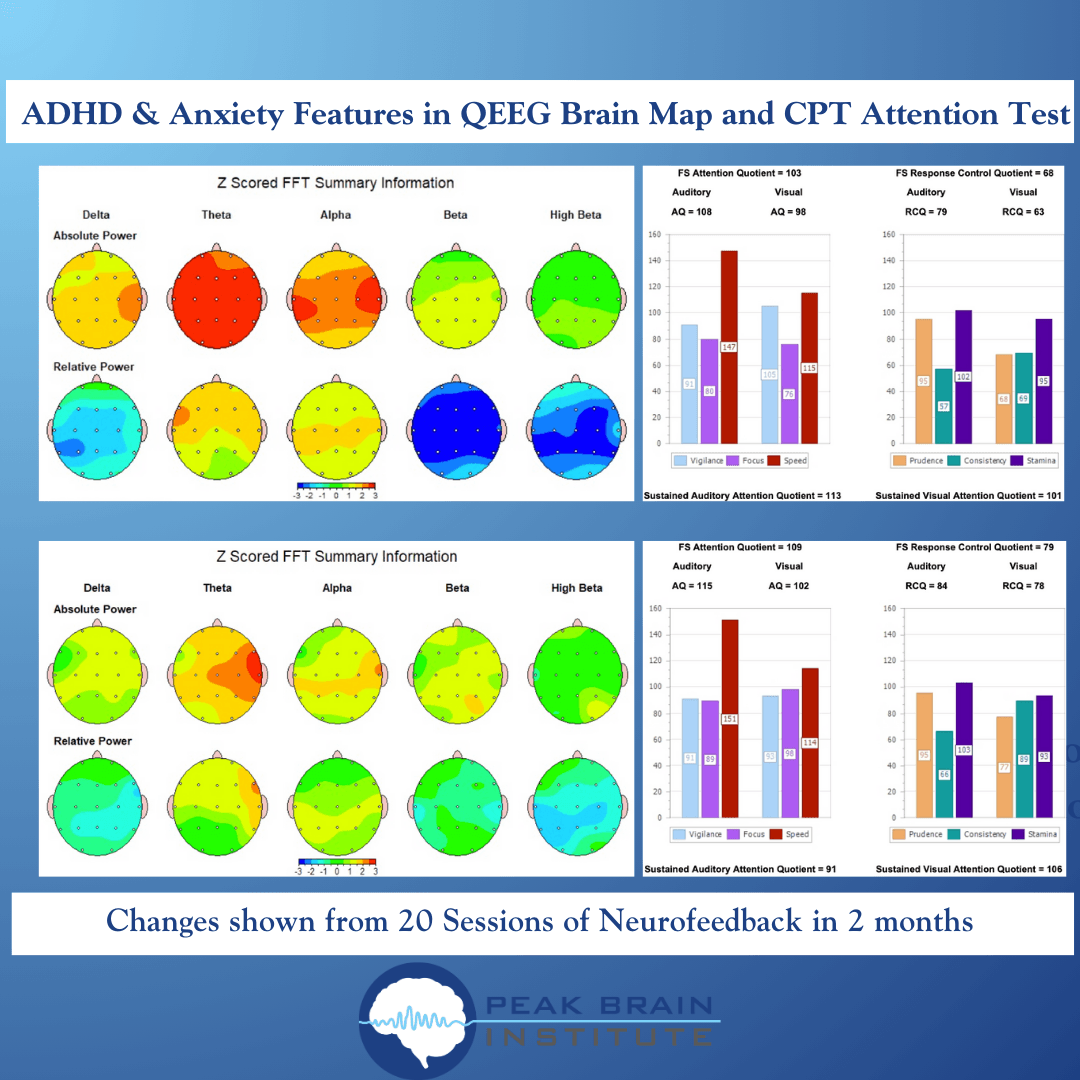
ADHD & Anxiety Features in QEEG Brain Map and CPT Attention Test - Changes shown from 20 Sessions of Neurofeedback in 2 months
Choosing a Type of Neurofeedback: Neurofeedback vs Biofeedback
All neurofeedback is a form of biofeedback, but not all biofeedback is a form of neurofeedback.
Put more simply, neurofeedback is a type of biofeedback, training the central nervous system, while the term biofeedback can also be used more broadly to include peripheral or body biofeedback. The central nervous system, or CNS, is the part of the nervous system within the bones of the skull and spine. Nerves outside of this are peripheral, or PNS. While Dr. Sterman (and many others since) focused on training of the sensorimotor rhythm, real-time neurofeedback can be done on many features of amplitude, frequency, or connectivity of brain parameters.
Peripheral and Central biofeedback (neurofeedback) can also be combined, but are done a bit differently. The peripheral form is mostly voluntary, where you practice things like breathing and relaxing, get some perceptible feedback, and over time develop skill transfer to be able to relax that way at will – i.e. learn to drop into the zone. Methods here including HRV biofeedback. Biofeedback (peripheral) are especially useful for pain management, with or without neurofeedback.
Neurofeedback on the other hand is largely involuntary – you cannot feel your brain waves, so they are hard to control. Also neurofeedback is “applauding” brainwave states or trends you just made in the past. The brain notices the feedback loop however (see Dr. Hill's research for evidence of that binding loop, or the brain noticing neurofeedback happening) – and the brain notices what is contingent to a brain wave pattern it just made.. i.e. “ah! dropping theta makes stuff happen, hmm!”, and over time this will exercise the resources in the direction that the game signals to move in.
There is not really a “best” form of neurofeedback – more that there are good providers and various tools that can be used to accomplish changes.
Using Central EEG Biofeedback, Peripheral Biofeedback, and pirHEG
At Peak Brain, we often use the peripheral measure of HRV or Heart Rate Variability training alongside neurofeedback to help support stress and anxiety, as well as sport performance goals. Something like HRV or hand-warming with a thermometer would fall squarely in the biofeedback category, while EEG training is strictly neurofeedback. They work very well together.
To make things a bit more complicated, we also use tools that measure blood-flow to the brain via infrared cameras – called pirHEG or passive infrared Hemoencephalography. pirHEG is a form of central biofeedback (neurofeedback) although feedback on heat that is generated by the brain, not EEG feedback. For pirHEG, you practice in a semi-voluntary way – concentrating to exercise vascular dynamics. We use HEG and related tools to try to offset migraines and brain fog from concussion and other metabolic insults, and also use these tools for goals around autism spectrum and other neurodevelopmental needs.
Ultimately, a good Brain Coach will use many tools, along with QEEG, to understand your brain activities and goals, and help you develop new resources through biofeedback and self-regulation – with tools used in a plan to support your desired changes.
How Do I Find a Neurofeedback Provider Near Me?
There are approximately 15,000 professional neurofeedback providers in the world, about one third of those are in North America, most in USA. If you are near a big city, you can likely find a neurofeedback provider by map searching QEEG or neurofeedback. Most will also be therapists, and provide behavioral therapy alongside the brain training. Be sure to look for people who not only provide neurofeedback services, but who use QEEG brain mapping to understand your brain and guide protocol selection. This can really make the difference in the effectiveness of neurofeedback.
When choosing a provider, the ability to communicate and get support in understanding your brain and developing more agency and control over time is key. While this process is often done by therapists, mental health professionals, and often done in the context of mental health conditions, use of neurofeedback training is a lot closer to personal training or physical therapy, where you iterate through protocols and change as you go, to meet the changing needs and performance.
Remote neurofeedback, or neurofeedback at home is also often available. Many providers will supervise and perform neurofeedback for clients, using equipment at home, either with periodic or live guidance as you train. Peak Brain has options for office training in our locations but we also support Remote Neurofeedback for clients all over the world. Even the QEEGs can be done remotely, but if you are near one of our offices you can do the brain maps in the office and train remotely, or in the offices, as you prefer.
Regardless of the provider you choose, getting support with biofeedback and neurofeedback interventions is key. It is also important to decide if you want to work with a therapist in the mental health model, i.e neurofeedback training alongside talk therapy support. Neurofeedback is often used by therapists who specialize in the treatment of ADHD in children or adults, children with Autism, developmental trauma or PTSD, or substance use disorders or drug addiction history, because neurofeedback can really help to get the brain out of the way, while the therapy provides tools to use the new brain resources.
There is a great history of neurofeedback being used as a treatment, by psych providers. At Peak Brain we treat the tools more like a lab and a gym – we help you learn how your brain works, and you tell us what goals you want to prioritize. We are also very happy to consult with and be part of your larger team, including any therapist or support doctors you have, although we don't have psychology services or “therapy”, and don't give you a diagnosis as much as education on your brain and resources.
Peak Brain does provide Mindfulness coaching support to help you learn to use those new resources in a more voluntary way. You can join our Mindfulness groups even if you don't do a Neurofeedback Program, but if you do neurofeedback we will throw in some private 1:1 instruction sessions with our dedicated Mindfulness Coaches, to help you build an ongoing practice, if that is a good fit for your goals and interests.
Neurofeedback Approaches to Avoid: Are There Side Effects?
We get asked a lot about what the best neurofeedback equipment is. The short answer is that most neurofeedback machines can be used to do good neurofeedback, but it can take some skill and guidance to get the most out of it. There are some systems that try to automate the process of choosing protocols, or that use the same training for everyone – those are types of neurofeedback training we don't use.
Also, we think it is very important to not “push through” impacts from the neurofeedback sessions that build up in the wrong direction. It takes many sessions to create building and lasting change, so you have time to observe impacts and tune the approach. Do not just train “through” side effects, especially ones that are building up in the wrong direction. Neurofeedback will often feel gently calming, focusing, or activating, for a few hours and then in the background for a day or so. When the wrong approach for your brain or your needs is used, those impacts are more noticeable, and sleep is usually eroded for that night – hard time falling or staying asleep. Think of it like working out too hard or with the wrong equipment form in the gym – you can sort of feel you pushed yourself. If you have some of these experiences after a session let your provider or Peak Brain Coach know – it will wear off until you spend several sessions or more reinforcing it. And how you felt – a bit too sleepy, too focused, etc – will likely help your neurofeedback therapist or Coach to improve the next session protocol for you.
The classic or typical neurofeedback process is also fully passive – no zapping. There are categories of neurofeedback that include both low energy micro-stimulation and pulsed EMF stimulation along with the EEG biofeedback. These tools are called Direct neurofeedback, and include brand names like LENS, IASIS, Direct, Clarity, and HPN. Peak Brain does not use those approaches. We also do not use full-head neurofeedback systems training “to” the QEEG databases in real-time; those systems are called Z-score training or LORETA training (for Low Resolution Electromagnetic Tomography, or a real-time source analysis).
In spite of the increased technical complexity in some of these other approaches we find the impacts may not be as specific or as controllable as a more traditional approach in the field. Instead we first use the QEEG to understand the brain and goals, and then train towards those goals, with specific and iterative protocols, tailored to you. We don't train you to be average, and we don't train you to the middle of the population bell curve in the QEEG databases. Who wants to be average!
Trying to select a neurofeedback provider and want to really get an expert in all the tools? We suggest finding someone who starts with QEEG brain mapping, works with you to understand your goals, and then systematically works through gentle 1-4 channel neurofeedback protocols 2-4x per week, to create changes gradually, with your input, re-assessing every 20-25 sessions with objective data, and guides the day to day changes based on your valid observations.
Ready to Learn More About Neurofeedback?
- Schedule a consultation now!
- Peak Brain Remote Neurofeedback programs – available anywhere
- Peak Brain Office Locations – USA
- ISNR: International Society for Neurofeedback and Research – professional trade organization
- AAPB: Association for Applied Psychophysiology and Biofeedback
- IQCB: professional training in QEEG
- Peak Brain Research Library – research by topics, and a full-text abstract dump of all papers
Explore Research by Topic
The evidence base for EEG biofeedback
ADHD & FocusAttention and executive function research
Anxiety & TraumaStress, mood, and trauma research
SleepInsomnia and sleep quality research
Performance & FlowPeak performance and creativity
Seizure & MigraineThe original neurofeedback application